Hours, directions, entrances and the best time to arrive
Château du Clos Lucé visitor guide
Château du Clos Lucé is Leonardo da Vinci’s final home, and the visit feels more like stepping through his last years than touring a grand Loire show-castle. The house itself is manageable, but the 7-hectare park, invention models, and galleries make this a longer, more spread-out stop than many visitors expect. The biggest difference between a rushed visit and a good one is leaving real time for the park after the interiors. This guide covers timing, entrances, tickets, pacing, and what to prioritize.
Quick overview: Château du Clos Lucé at a glance
If you want the short version before you plan the rest, start here.
- When to visit: Open daily from 9am–7pm from February to June and September to October, 9am–8pm in July and August, 10am–6pm in January, and 9am–6pm in November and December; the first hour after opening is noticeably calmer than late morning because school groups and family traffic build once visitors finish Château Royal d’Amboise nearby.
- Getting in: From €20 for standard entry, with family tickets from €60 and a French guided tour add-on from €4.80 when scheduled; booking ahead is smart on weekends, school vacations, and summer afternoons, while quieter weekdays are usually more forgiving.
- How long to allow: 3–3.5 hours works for most visitors, and families or Leonardo enthusiasts can easily turn it into a half-day once the park and galleries are included properly.
- What most people miss: Anne of Brittany’s oratory, the restored living workshops, and the giant translucent canvases in the park are the parts people rush past when they treat the park as an optional add-on.
- Is a guide worth it? A live guide adds value if you want the Francis I and final-years context, but for most independent visitors the multilingual visitor guide and park audio installations are enough.
Jump to what you need
🕒 Where and when to go
🗓️ How much time do you need?
Visit lengths, suggested routes and how to plan around your time
🎟️ Which ticket is right for you?
Compare all entry options, tours and special experiences
🗺️ Getting around
How the château and park are laid out and the route that makes most sense
🏰 What to see
Leonardo’s bedroom, living workshops, and the invention park
♿ Facilities and accessibility
Restrooms, lockers, accessibility details and family services
Where and when to go
How do you get to Château du Clos Lucé?
Clos Lucé sits just above Amboise’s historic center, around a 5-minute uphill walk from town and roughly 400m from Château Royal d’Amboise.
2 Rue du Clos Lucé, 37400 Amboise, France
- Walk: Amboise town center → 5-min walk → easiest if you’re already in the old town or coming from the Royal Château.
- Train: Amboise TER station → about 25-min walk → local buses also connect the station and town center year-round.
- TGV + connection: Saint-Pierre-des-Corps → local rail or road connection → the TGV leg from Paris is fast, but the last stretch still needs planning.
- Car: Private car park on Rue du Clos Lucé → about 5-min walk → useful for multi-château days, but you’ll still finish on foot.
- Bike: Bicycle garage opposite the ticket office → near the entrance → handy for Loire à Vélo riders, with secure lockers onsite.
Which entrance should you use?
Most visitors don’t struggle with multiple entrances here — they struggle with the two ticket offices. The site itself is straightforward, but drivers and walkers often head to different starting points without realizing both lead into the same visit flow.
- Main ticket office: Located at 2 Rue du Clos Lucé. Best for visitors arriving on foot from Amboise town center or Château Royal d’Amboise.
- Secondary seasonal ticket office: Opposite the car parks. Best for drivers in April–August when visitor numbers are higher.
When is Château du Clos Lucé open?
- January: 10am–6pm
- February–June: 9am–7pm
- July–August: 9am–8pm
- September–October: 9am–7pm
- November–December: 9am–6pm
- Closed: December 25 and January 1
- Last entry: Plan to clear the ticket office at least 1 hour before park closing, because the château and ticket office close 1 hour before the park.
When is it busiest? Late morning to mid-afternoon in July and August, plus weekends and school-vacation periods, feel busiest because families linger in the park and the visit naturally stretches out.
When should you actually go? Right at opening in spring or early fall gives you quieter château rooms first and more breathing room in the park before lunch traffic builds.
How much time do you need?
| Visit type | Route | Duration | Walking distance | What you get |
|---|---|---|---|---|
Highlights only | Entrance → château rooms → Leonardo’s bedroom → workshops → short park loop → exit | 1.5–2 hours | ~1km | You cover the essential interiors and a taste of the park, but you’ll skim the invention route and miss the slower outdoor sections that give the visit its personality. |
Balanced visit | Entrance → château rooms → oratory → workshops → painter and architect galleries → main park model loop → exit | 3–3.5 hours | ~2km | This is the sweet spot for most visitors because it gives the house, galleries, and core park route proper time without turning the visit into an all-day commitment. |
Full exploration | Entrance → full château route → workshops → galleries → full Leonardo da Vinci Park loop → garden → picnic or café break → exit | 4+ hours | ~3km | You get the complete indoor and outdoor experience, including the quieter sections most people cut, but it’s a longer, more walk-heavy visit than many Loire château stops. |
Which Château du Clos Lucé ticket is best for you
| Ticket type | What's included | Best for | Price range |
|---|---|---|---|
Standard admission | Château entry + Leonardo da Vinci Park + Leonardo galleries + visitor guide + park audio installations | A visit where you want the full Clos Lucé experience without overcomplicating the day with add-ons or transport-heavy extras. | From €20 |
Family ticket | Château entry + park + galleries + family pricing for 2 adults and 2–4 children | A family day where you want the park, invention models, and kid-friendly pacing without paying separate adult-and-child rates. | From €60 |
Historical guided tour add-on | Entry + 1-hour historical guided visit in French | A visit where you want stronger context on Leonardo’s final years and you’re comfortable following a French-language tour. | From €36.30 |
Clos Lucé + Château Royal d’Amboise combined ticket | Clos Lucé entry + Château Royal d’Amboise entry | A same-day Amboise plan where you want Leonardo’s home and the royal setting within an easy walking route. | From €36.30 |
Clos Lucé + Amboise + Chambord combined ticket | Clos Lucé entry + Château Royal d’Amboise entry + Chambord entry | A Loire day with transport already sorted, where you want one Leonardo thread running from Amboise to Chambord. | From €49.73 |
How do you get around Château du Clos Lucé?
Clos Lucé is best explored on foot, and the full route is large enough to need a little pacing rather than strict navigation. The château comes first, while the park opens the visit out behind and around it.
Getting around the site
- Château rooms: Leonardo’s bedroom, domestic interiors, chapel, and royal rooms → 45–60 minutes.
- Living workshops: Recreated studio, library, and study spaces → 20–30 minutes.
- Painter and architect galleries: Leonardo’s ideas as painter, architect, and court thinker → 20–30 minutes.
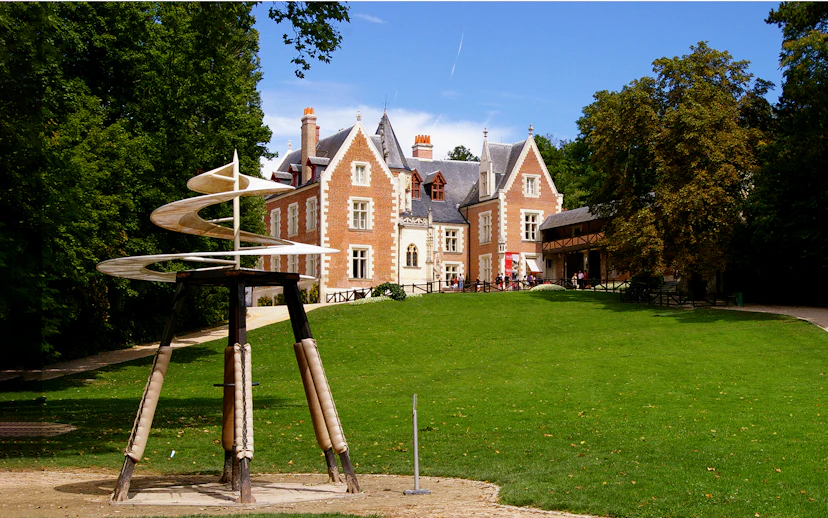
- Leonardo da Vinci Park: Life-size invention models, giant canvases, bridges, and water features → 60–90 minutes.
- Leonardo’s Garden: Slower botanical and observation-based section → 15–20 minutes.
Suggested route: Start indoors with the château and workshops, then move into the galleries, and only then take the main park loop; that order works because the outdoor machines make far more sense once Leonardo feels like a person, not just a name.
Maps and navigation tools
- Map: Printed visitor guide at entry → covers the main visit spaces and park route → pick it up at the ticket office before you start.
- Signage: Main wayfinding is good enough for the core route, but the guide helps you avoid zigzagging through the park and missing quieter stops.
- Audio guide / app: There isn’t a full room-by-room app, but 8 park audio installations are available in English, French, Italian, and German and add real value outdoors.
💡 Pro tip: Don’t head straight into the park first — the invention models land much better once you’ve already seen Leonardo’s bedroom and workshops inside.
What is Château du Clos Lucé worth visiting for?

1/6
Leonardo’s bedroom
Attribute — Space type: Restored Renaissance private room
This is the emotional center of the site because it’s the room associated with Leonardo’s final days in Amboise. It’s easy to pass through quickly, but this is the point where the visit shifts from ‘famous inventor’ to a real person living at court in France. Most visitors pause for the name and move on; the stronger moment is noticing how modest the space feels for someone so mythologized.
Where to find it: Inside the château on the main interior route, after the opening domestic rooms.
Leonardo’s living workshops
Attribute — Space type: Recreated studio and study
The workshops are where Clos Lucé stops being just a historic house. You get Leonardo as a working mind — surrounded by books, tools, studies, and unfinished thinking — rather than a museum icon reduced to the Mona Lisa. What many people miss is that this restored area was designed to reconnect his ideas across art, engineering, and daily work, so it deserves more than a quick glance.
Where to find it: Ground floor of the château, on the restored workshop route.
Anne of Brittany’s oratory
Attribute — Era: Late Gothic and early Renaissance devotional space
This small oratory is easy to skip because visitors tend to push on toward the more obviously ‘Leonardo’ rooms. It matters because it keeps the site rooted in its earlier royal life and adds texture beyond the final-years story. The detail most people miss is the painted decoration linked by the site to Leonardo’s pupils, which makes the room more than just a chapel stop.
Where to find it: Inside the château, along the upper interior route with the royal rooms.
The life-size invention models
Attribute — Type: Interactive engineering installations
These are the reason families often leave loving Clos Lucé more than they expected. Instead of staring at sketches behind glass, you walk among full-scale machines, bridges, and transport ideas that turn notebook concepts into physical objects. The mistake most visitors make is treating them like a children’s zone; they’re actually the clearest bridge between Leonardo’s drawings and his working imagination.
Where to find it: Throughout the Leonardo da Vinci Park behind the château.
The giant translucent canvases
Attribute — Type: Outdoor interpretive installation
These suspended panels are one of the site’s quietest high points, partly because they don’t shout for attention like the bigger machines. They thread painting, anatomy, architecture, and observation through the landscape itself, which makes the park feel curated rather than scattered. Many visitors walk straight from one model to the next and miss how these canvases slow the route down in exactly the right way.
Where to find it: Along the wooded park route between the main invention stops.
Leonardo’s Garden
Attribute — Type: Landscape and observation space
If the park models show Leonardo the engineer, the garden shows Leonardo the observer. It’s less dramatic than the machines, which is why it gets cut when people are short on time, but it explains how closely his ideas came from water, plants, stones, and natural movement. The thing most people miss is that this is one of the best places to end the visit because it calms the pace after the busier invention loop.
Where to find it: Within the later part of the park route, beyond the main model clusters.
Facilities and accessibility
- 🎒 Lockers: Secure lockers are available at the main reception near the bicycle storage, which is useful if you don’t want to carry bags through both the château and the park.
- 🚻 Restrooms: Adapted toilet blocks are available onsite, including low-level basins, step stools, and an adapted washbasin for families.
- 🍽️ Cafés and restaurants: La Terrasse Renaissance, La Table du Moulin, and L’Auberge du Prieuré cover everything from quick snacks to a sit-down meal, with the strongest choice spread across the warmer months.
- 🪑 Seating and rest areas: The shaded picnic area in the park is the best place to pause if you’re visiting with children or want to break up a longer route.
- 🍼 Family facilities: Bottle-heating facilities are available onsite, which makes a longer family visit much easier than at many Loire château stops.
- 🚲 Bicycle garage: A bicycle garage sits opposite the ticket office, which is especially useful for Loire à Vélo riders arriving with gear.
- 🅿️ Parking: The private car park on Rue du Clos Lucé is about 300m from the entrance, and there is also one disabled parking space next to the site.
- ♿ Mobility: The ground floor, basement, and entire park are accessible, and a wheelchair can be borrowed with ID, but the full upper-floor château route is not the part to assume is step-free.
- 🦽 Wheelchair loan: A wheelchair is available onsite against ID, which is helpful because the visit is longer and more park-heavy than many people expect.
- 🅿️ Accessible parking: One disabled parking space is available next to the site, which matters because the main private car park still leaves a short walk to the entrance.
- 👂 Hearing support: Transcripts for the park audio installations are available at the ticket office for visitors who are deaf or hard of hearing.
- 👨👩👧 Families and strollers: Pushchairs work in the park, but inside the château the site asks visitors to use a baby carrier so movement stays manageable in the interior rooms.
- 🌳 Outdoor terrain: The park is a major part of the experience, so even on an accessible route you should still plan for a longer outdoor circuit rather than a quick indoor-only stop.
Clos Lucé works very well for children because the visit is not built around quiet rooms alone — it mixes a house, machines, outdoor space, and hands-on curiosity in one route.
- 🕐 Time: Around 3 hours is realistic with children, and it’s worth prioritizing the workshops and park instead of trying to rush every room upstairs.
- 🏠 Facilities: The shaded picnic area, bottle-heating facilities, and adapted family restrooms make this a more practical stop with younger children than many château interiors.
- 💡 Engagement: Pick up the Inventor’s Notebook for ages 7–12, because it gives children a job to do instead of leaving the château section feeling like the part to endure.
- 🎒 Logistics: Bring a baby carrier if needed and keep the stroller for the park, because that split is the easiest way to avoid frustration indoors.
- 📍 After your visit: Château Royal d’Amboise is only about 400m away, so it’s the easiest next stop if your group still has energy after Clos Lucé.
Rules and restrictions
What you need to know before you go
- Entry requirement: You’ll need a valid admission, family, or combo ticket, and all visitors start through one of the site’s ticket offices rather than walking straight into the route.
- Bag policy: Secure lockers are available at main reception if you want to travel lighter between the château and the park.
- Visit flow: Clos Lucé works best as one continuous visit because the château, galleries, and park are designed to build on each other in sequence.
Not allowed
- 🐾 Pets: Dogs are allowed, but they must be carried inside the buildings and kept on a lead in the grounds.
- 🛒 Strollers in the château: Pushchairs are discouraged inside the château, where the site asks visitors to use a baby carrier instead.
- 🖐️ Historic interiors: Treat the furnished rooms as historic interiors rather than hands-on spaces, even though selected outdoor park models are designed to be interactive.
Photography
Personal photography fits naturally into most visits, especially in the park around the invention models and landscape installations. Inside the château, follow any room-level instructions and staff guidance, because preserved interiors and devotional spaces are the parts most likely to have stricter handling or flash expectations than the outdoor route.
Good to know
- The park is not the add-on: If you skip the park, you’re missing a core part of what makes Clos Lucé different from other Loire château visits.
- Language setup: The self-guided visit works well in English, but the regular historical guided tour for individual visitors is geared to French speakers.
Practical tips
- Booking and arrival: Book ahead for weekends, school vacations, and summer afternoons, but on quieter weekdays the real risk is not sellout — it’s arriving too late to give the park its due before the château and ticket office close 1 hour before the park.
- Pacing: Save energy for the park, because the biggest mistake here is using up your attention on the indoor rooms and then treating the life-size models as a quick walk-through.
- Crowd management: The 9am opening is your best friend from spring through fall, especially if you’re pairing Clos Lucé with Château Royal d’Amboise and want the interiors before late-morning family traffic builds.
- What to bring or leave behind: Bring a baby carrier if you’re visiting with a stroller-age child, because pushchairs are for the park, not the château interior.
- Food and drink: If you’re visiting with children, picnic in the shaded park area or plan lunch after the first indoor hour, because stopping too early can break the visit’s flow before the invention route starts paying off.
- Route planning: Pair Clos Lucé with Château Royal d’Amboise on foot, not with an overambitious same-day dash to multiple far-flung châteaux unless you’ve already sorted transport.
- Weather: Bad weather doesn’t ruin the visit, but it does cut into one of the site’s best assets — the outdoor invention route — so this is a stronger pick on a dry day than a rainy one.
What else is worth visiting nearby?
Commonly Paired: Château Royal d’Amboise
Distance: 400m — about 5 minutes on foot
Why people combine them: This is the most natural same-day pairing in Amboise because the two sites connect Leonardo’s final home with the royal court that brought him to France.
✨ Château du Clos Lucé and Château Royal d’Amboise are most commonly visited together — and simplest to do on a combo ticket. The practical advantage is that you keep the whole day on foot and avoid breaking the Leonardo thread with extra transport.
Commonly Paired: Amboise old town
Distance: 300m — about 5 minutes on foot
Why people combine them: It’s the easiest place to break the day for lunch, river views, or a slower walk after the park without needing a car or transfer.
Also nearby
Loire riverfront
Distance: About 10 minutes on foot from Clos Lucé via town
Worth knowing: It’s the easiest low-effort add-on if you want a breather after the park rather than another ticketed site.
Amboise market streets
Distance: About 5–10 minutes on foot
Worth knowing: They work well for a coffee or late lunch after the visit, especially if you don’t want to commit to another château the same day.
Eat, shop and stay near Château du Clos Lucé
- On-site: La Terrasse Renaissance serves crêpes, salads, and light meals with château views, and it’s worth it if you want to stay onsite rather than break the visit.
- La Table du Moulin: In the Leonardo da Vinci Park, this is the practical choice for sandwiches, salads, grills, desserts, and drinks when you want something quick without leaving the route.
- L’Auberge du Prieuré: This is the most atmospheric onsite option, with Renaissance-inspired cuisine and a stronger meal break if you’re building a slower half-day around Clos Lucé.
- Picnic area: If you’ve brought your own food, the shaded picnic tables in the park are the best-value option, especially with children.
- 💡 Pro tip: Eat after the château rooms and before the longer park loop — stopping too early can make the visit feel chopped up, while leaving food too late turns the final outdoor section into a tired march.
Amboise is a very good base if Clos Lucé is one of your priority stops. You can walk to both Clos Lucé and Château Royal d’Amboise, avoid bigger-city logistics, and keep meals simple. If you want a larger hotel pool and stronger rail convenience, Tours is easier, but it’s less rewarding as a walk-out-the-door château base.
- Price point: Amboise tends to skew mid-range with some charming smaller stays, while Tours usually gives you more choice across budget and business-style hotels.
- Best for: Short Loire stays where you want to walk to key sights and keep transport friction low.
- Consider instead: Tours if you want a bigger-city base with stronger rail links, or a countryside stay near Amboise if you’re driving and planning longer multi-château days.
Frequently asked questions about visiting Château du Clos Lucé
Most visits take around 3 hours, and 3.5 hours is more realistic if you also want the galleries and a slower park route. Families and Leonardo enthusiasts can easily turn it into a half-day because the outdoor installations are a major part of the experience, not a quick garden walk at the end.
Booking ahead is a good idea for weekends, school vacations, and summer visits, but it’s more about smoothing entry than beating a strict timed-entry system. On quieter weekdays, same-day admission is usually more manageable, though prebooking still saves time at the ticket office.
Arriving right at opening is the best move if you want the château rooms before the park gets busier. That matters more here than at smaller indoor sites because the visit naturally stretches into 3 hours or more, and late starts are what make people rush the park.
Yes, but carrying less makes the visit easier because you’ll be moving between indoor rooms and a fairly large outdoor park. If you want to travel lighter, secure lockers are available at main reception near the bicycle storage.
Personal photography fits naturally into most visits, especially outdoors in the park. Inside the château, follow room-level signs and staff guidance, because preserved interiors can be handled differently from the open-air invention route.
Yes, and groups can get more out of the site than independent visitors if they want structured interpretation. That’s especially relevant for English speakers, because the regular individual historical guided visit is aimed at French speakers, while English guided formats are tied to group arrangements.
Yes, it’s one of the more family-friendly Loire château stops because it mixes a historic house with interactive models, open space, and practical family facilities. The biggest win is the park, where children can engage with Leonardo’s inventions instead of being limited to room-by-room looking.
Partially, yes. The ground floor, basement, and entire park are accessible, and a wheelchair can be borrowed with ID, but you shouldn’t assume the full château route is step-free because upper-floor access is not the part to take for granted.
Yes, there are several onsite options, including La Terrasse Renaissance, La Table du Moulin, and L’Auberge du Prieuré. If you’d rather keep costs down or need flexibility with children, the shaded picnic area in the park is also a very practical option.
Yes, dogs are allowed, but the rules are stricter indoors than outdoors. They must be carried inside the buildings and kept on a lead in the grounds, so this is a workable stop for dog owners as long as you plan for that split.
Yes, but it works best as a proper Loire Valley day trip, not a casual half-day outing. The rail journey is fast enough to make it possible, but the visit itself still needs around 3 hours, and the onward connection to Amboise is what makes planning matter.
Yes, for most visitors that’s the smartest pairing. The two sites are only about 400m apart, they connect neatly on foot, and together they tell the fuller story of Leonardo’s final years and his relationship with the French court.